Category: Uncategorized

  • What The Census Suggests

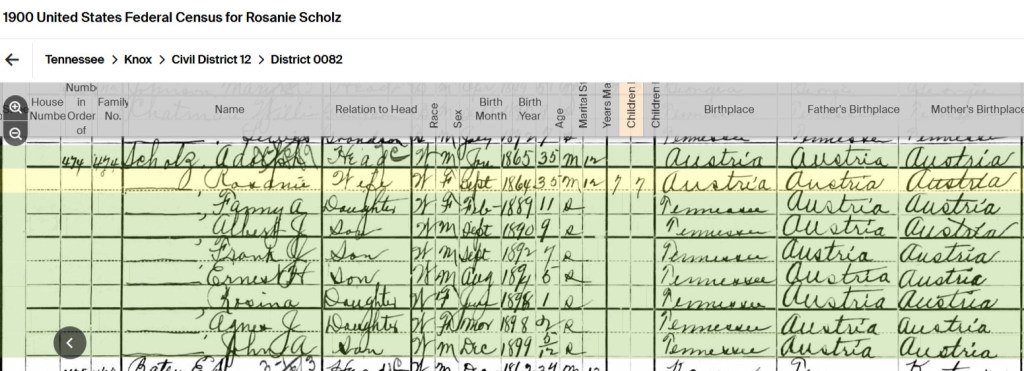
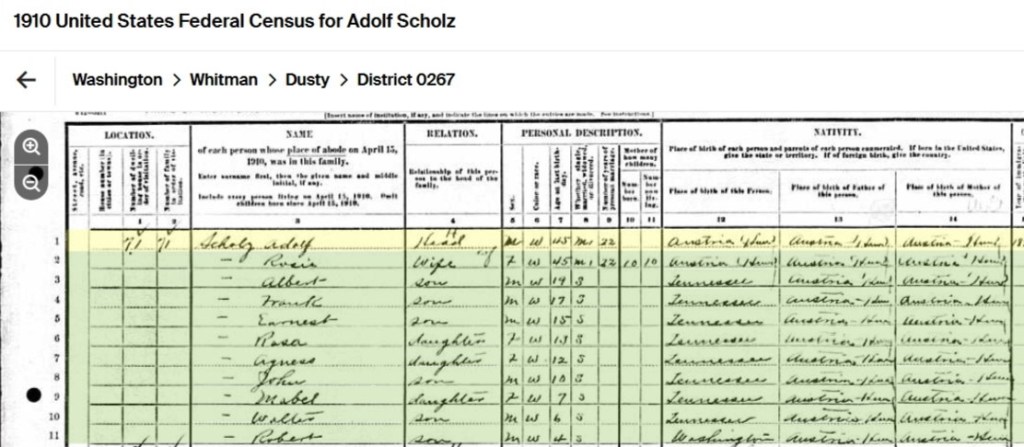
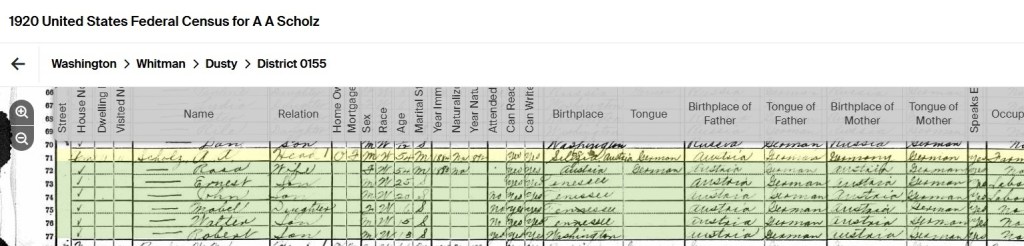
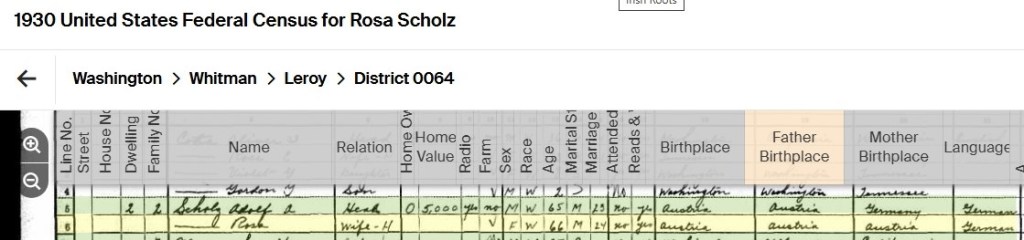
    Adolph Scholz was my husband’s Great Grandfather. He appeared in the 1900, 1910, 1920 and 1930 census. His birth country was always given as Austria. Adolph is always in the top row.

    1900 Census

    1910 Census

    1920 Census

    1930 Census

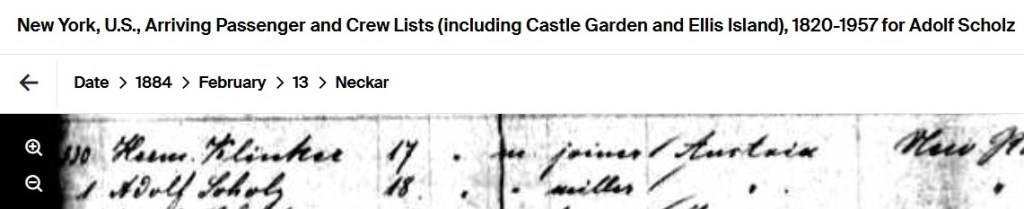
    I have even have Adolph’s arrival record in New York. It also said Austria. He had travelled with his friend Hermann Klinke.

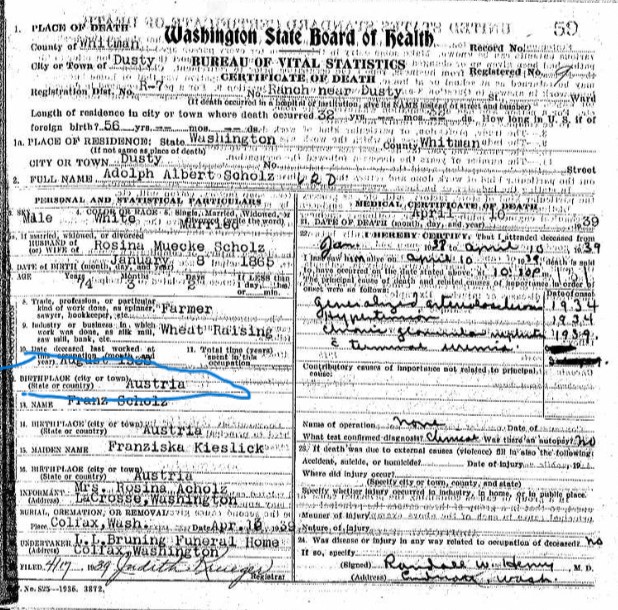
    His death certificate also said that he was born in Austria

    You would think by now that he was born in that country. I believed it for a very long time, until one day it occurred to me that he was born in Schlesien (Silesia) which has nothing to do with Austria at all. We always knew his birth town, which was Schönwiese Kreis Leobschütz.

    There are lots of villages called Schönwiese in Germany as well as Austria, may be even Switzerland. Europe was always unstable, many wars with lots of border changes, so I thought, may be Schönwiese was in Germany and then became part of Austria or the other way around. The answer has always been no.

    Schönwiese is in the famous Meyers Gazetteer which tried to list every town and village in the German Empire (1871-1918). Meyers Gazetteer was published in 1912. The link for Schönwiese is here. There are twenty different Schönwiese listed in the Gazetteer.

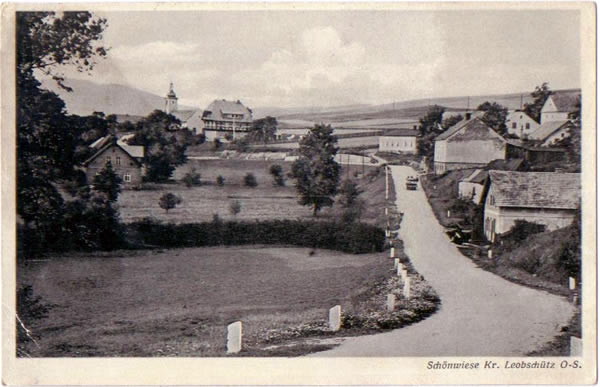
    I also have a copy of a postcard from Schönwiese which should have given me a clue a long time ago.

    The description says Schönwiese Kreis Leobschütz, Oberschlesien which stands for Upper Silesia. Upper Silesia used to be in Germany.

    Adolph’s wife came from the town of Hof in Moravia, Austria. The census was always correct.

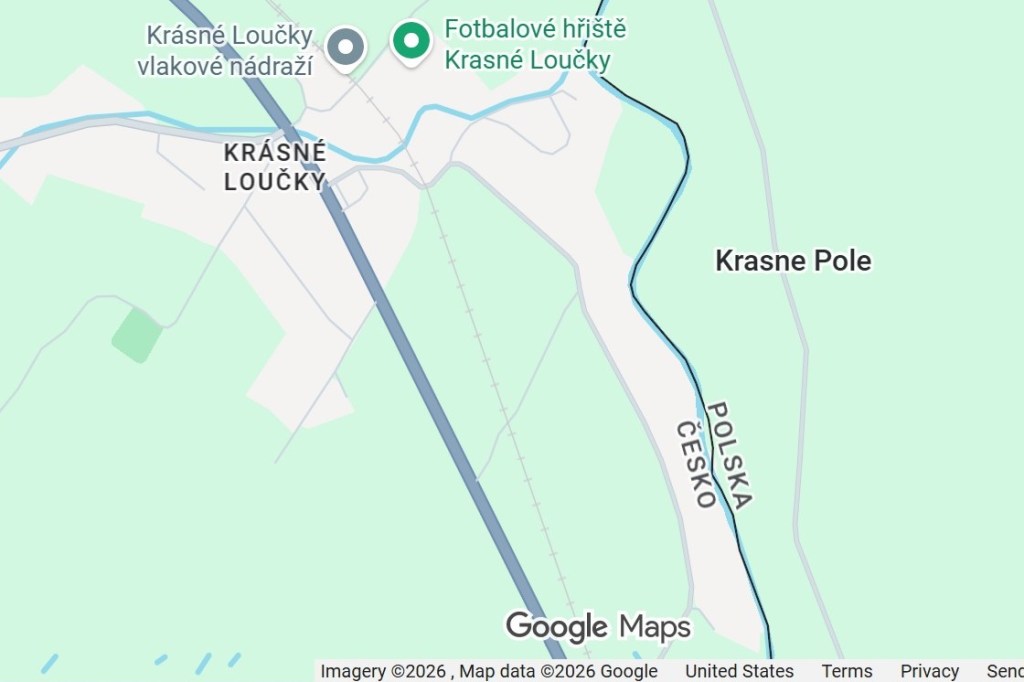
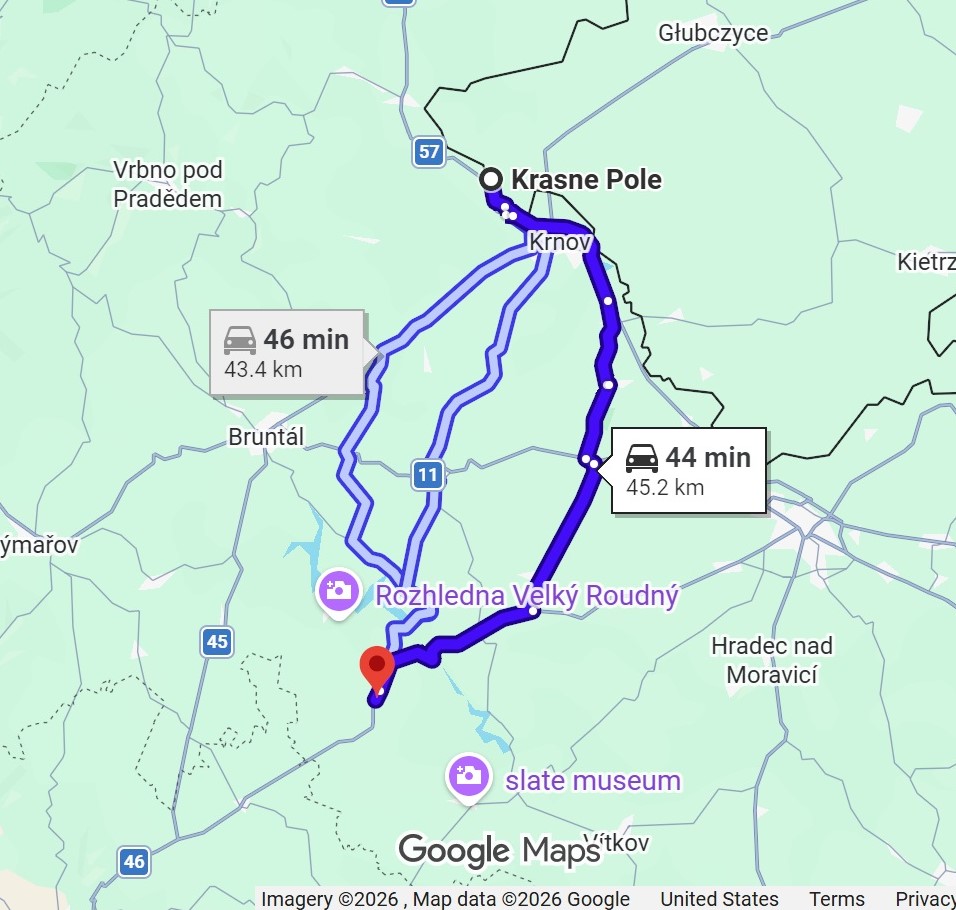
    Let’s look at a current map of where Schönwiese, which is now called Krasne Pole, is located.

    Krasne Pole on the right located in Poland, which back in the day was Prussia, and on the left side is Cesko or Czech Republic which used to be Austria. Schönwiese was literally just a couple of miles away from the Austrian border.

    Adolph’s future wife Rosina Mücke grew up only about a 45 minute drive from him in Hof, Moravia, Austria now called Dvorce u Bruntalv.

    My husband and I are planning on visiting both villages eventually.

    So what is the moral of the story. Don’t trust census records? Not really! Instead gather all your facts and locations you have for an ancestor. Try to figure out where they came from. Geography is a very important part and history as well. The problem can be a language barrier, however these days google and other translators can help with that.

    The only question I have, why did Adolph lie? May be he was afraid that the German Empire would come after him, so he decided to just say that he was from Austria.

    Adolph’s naturalization and passport application are not online. Those can be very helpful in researching the birth locations. He went back to Europe to visit his family in Schönwiese in 1910.

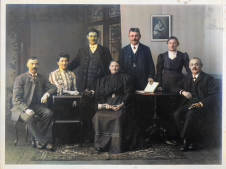
    Adolph with his Mother, Franziska, and some of his siblings.

    Do you trust the census? Have you found a discrepancy in your research?

    Please leave a comment below!

  • The Appel Family

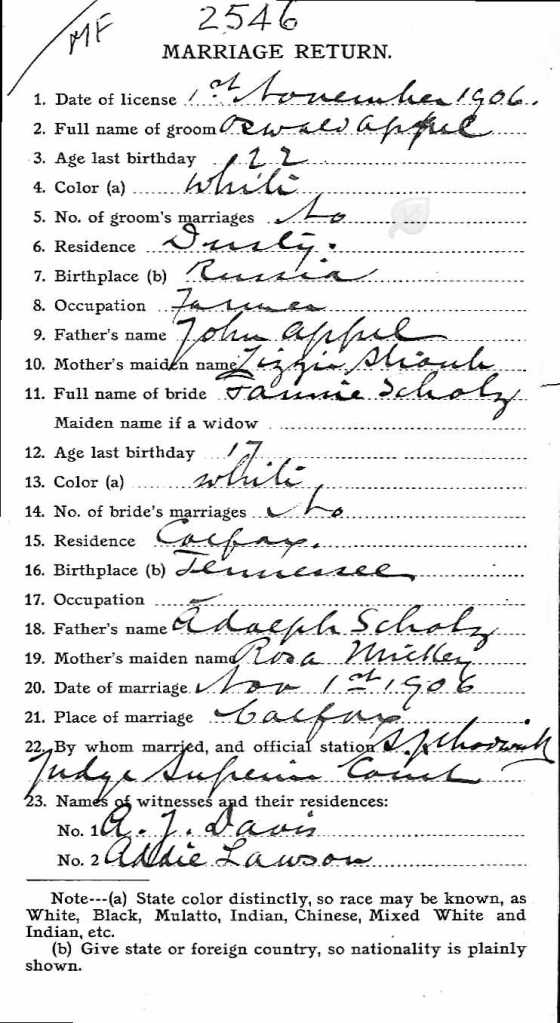
    My husband’s Grandfather, Bob Scholz, had told me a long time ago that there were lots of Appels in the family. I didn’t know what that meant at the time, not until I started genealogy. Grandpa who was born in 1906, in the state of Washington, was the youngest of ten children. All the other siblings were born in Tennessee. The oldest one was his sister Fannie who was born 20 February 1889 in Oliver Springs. Fannie married Oswald Appel 7 November 1906 in Colfax, Washington.

    I was surprised to find out that Oswald was from Russia. His father’s name was Johann or John. His mother’s name was Elizabeth Kraft. These names were German. The German word for apple is Apfel. In some parts of Germany you say “Appel”. So where did the Appels family come from?

    Back in the day when German families started to immigrate to the colonies or the Americas, some of them went to Russia instead. They were promised religious freedom and land by Catherine the Great and they settled in the Russian Volga River region. Oscar’s family lived in that region for about 100 years. They kept their German language and traditions. That all changed in the 19th century, when land purchases were limited, mandatory military service and they had to speak Russian. There was also a famine in that area. So, Oscar and his extended family left for America. Some of the neighbors went to Canada, South America and other countries.

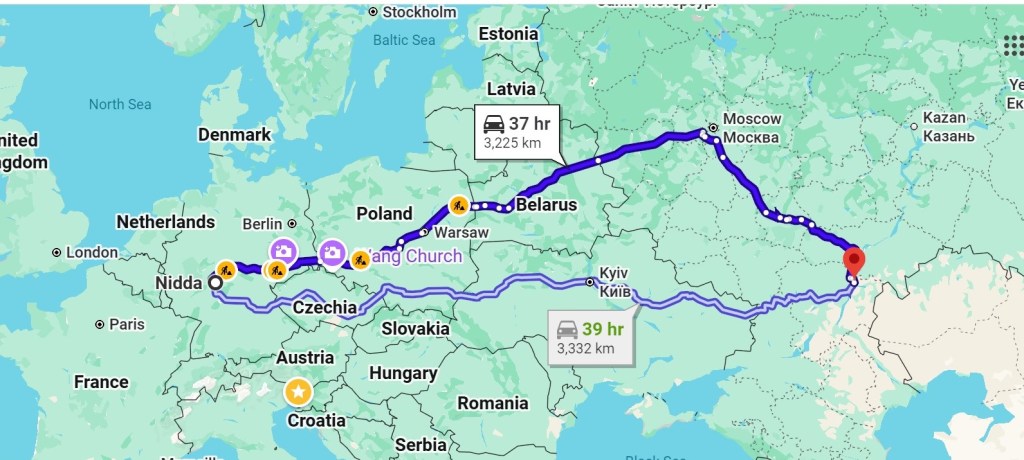
    Someone did the research and found out where the Appels came from in Germany. It’s a village in Hessen, called Nidda. Oscar’s 4th Great Grandfather, Peter Appel was born there in 1717 and died in 1759. Oscar was born in the town of Holstein, Russia now called Verkhnyaya Kulalinka. With the Russian name I was able to look it up on google map. It’s quite a distances from Nidda, about 3400 km or 2100 miles.

    There is a great website called The Volga Germans about the settlements.

    Oswald was only 5 years old when he immigrated to America in 1888 with his parents. He and Fannie had seven children, Frances, Harold, Donald, Calvin, Dorothy, Eugene and Wilma. They had lots of grandchildren. Frances had 5, Harold 2, Donald 9, Calvin 5, Dorothy 5, Eugene 4 and Wilma had 4. That’s a grand total of 34! Oswald also had six siblings, Leopold, Rosa, Eigen (Eugene), Marie, Rosalie and John. Leopold had 9 children, Rosa 6, Eugene 2, Marie 6 and John had 4.

    So, there are lots of Appels to go around with deep German roots!

    Do you have Volga German ancestors? Please leave a comment below!

  • Records That Add Color

    I am participating once again in Amy Johnson Crow’s 52 Ancestors in 52 weeks challenge. This week’s headline is A Record That Adds Color.

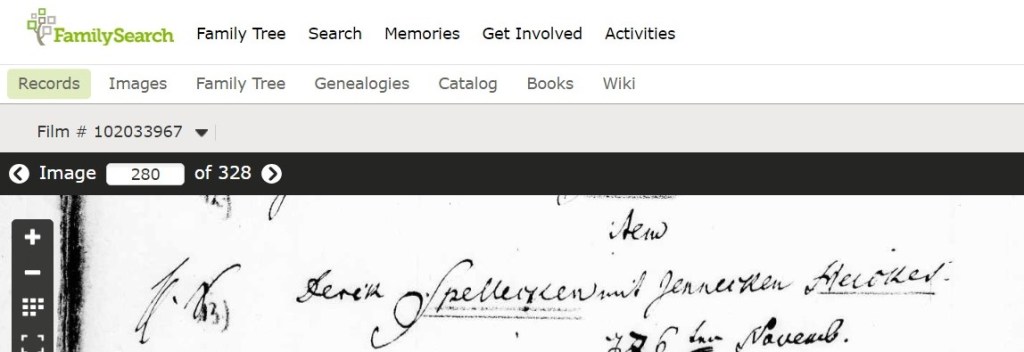
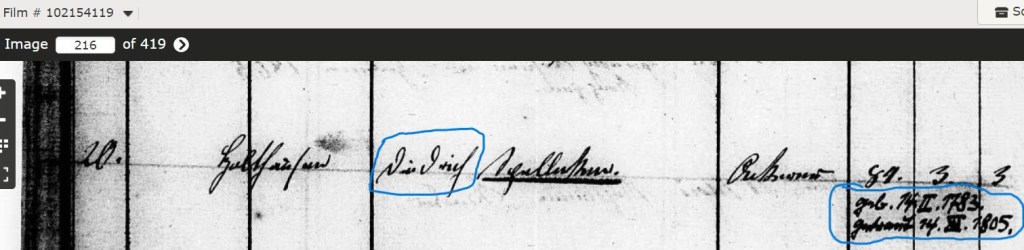
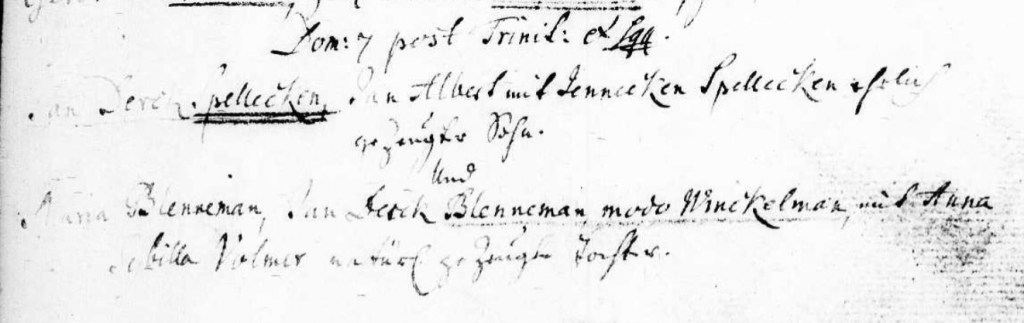
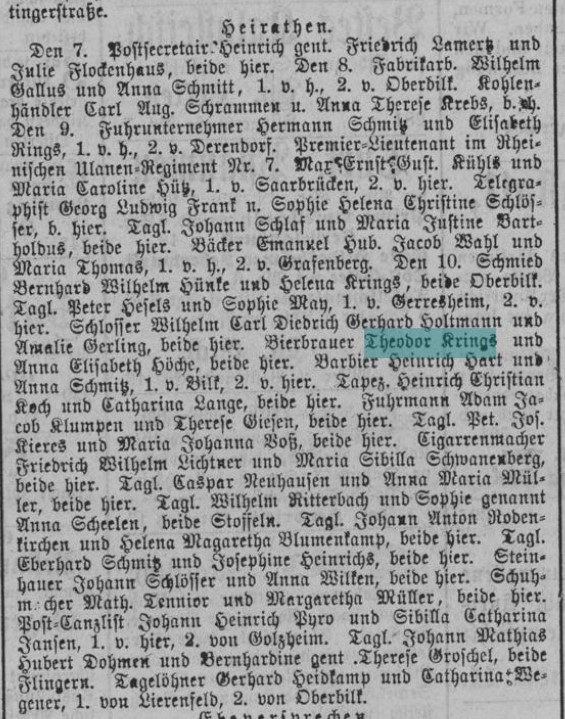
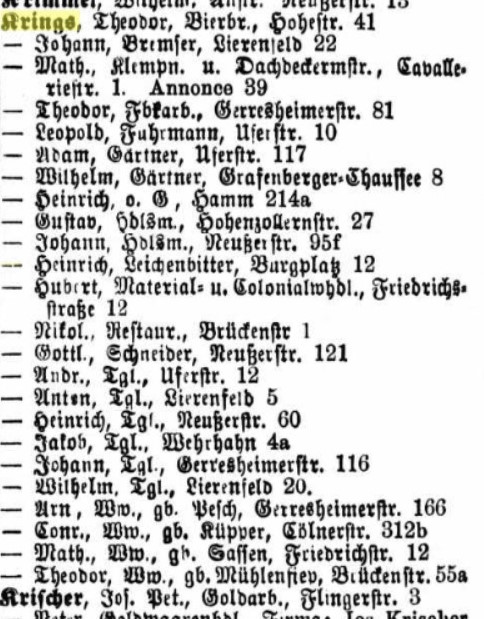
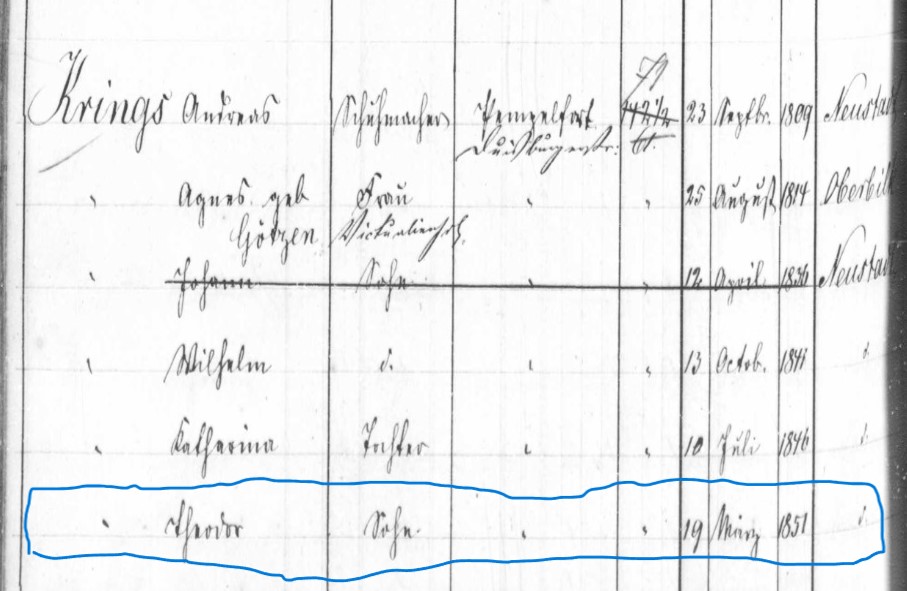
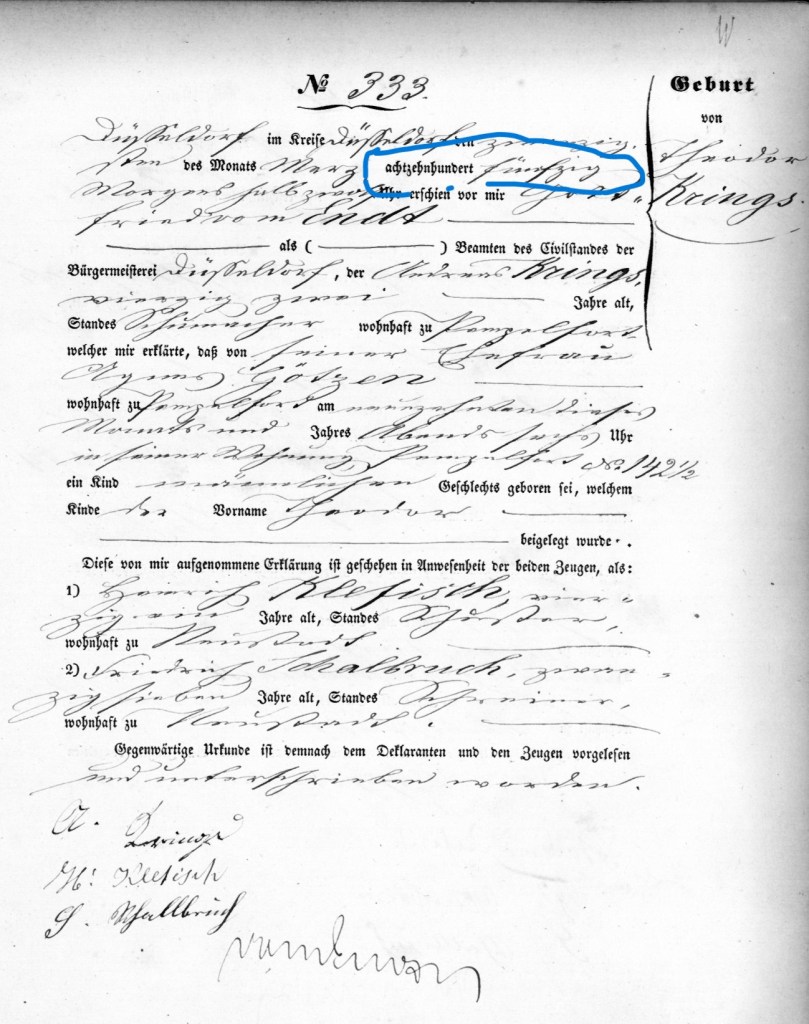
    I do have lots of birth, marriage and death records for my ancestors and their extended families. Each record is unique and it is nice to have a copy of the original ones. Indexed records for example on the Family Search Website, will only give you dates, however you won’t find witnesses, signatures and professions. So I decided to look at all the jobs my ancestors and their extended families had starting with my paternal line.

    My Dad had his own flower wholesale business. He would pick the cut flowers up in the early morning at the auction house and then deliver them all over Düsseldorf.

    My Grandfather also had his own business. He had an upholsterer and decoration shop. His business was advertised in the 1926 Düsseldorf directory.

    My Great Grandfather was a gardener. All those beautiful parks in Düsseldorf had to be maintained.

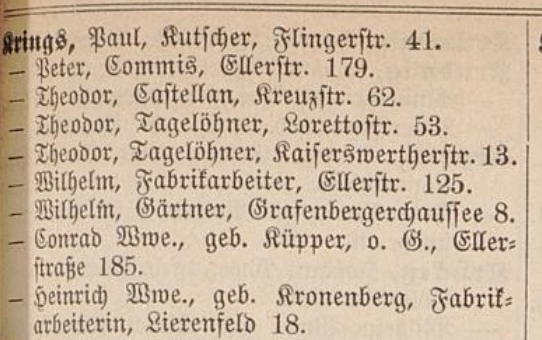
    His name and profession were in the 1881 Düsseldorf directory. It is the second Wilhelm.

    My 2x Great Grandfather was a shoemaker and his wife, my 2x Great Grandmother had her own grocery shop. They were both in the 1855 Düsseldorf directory.

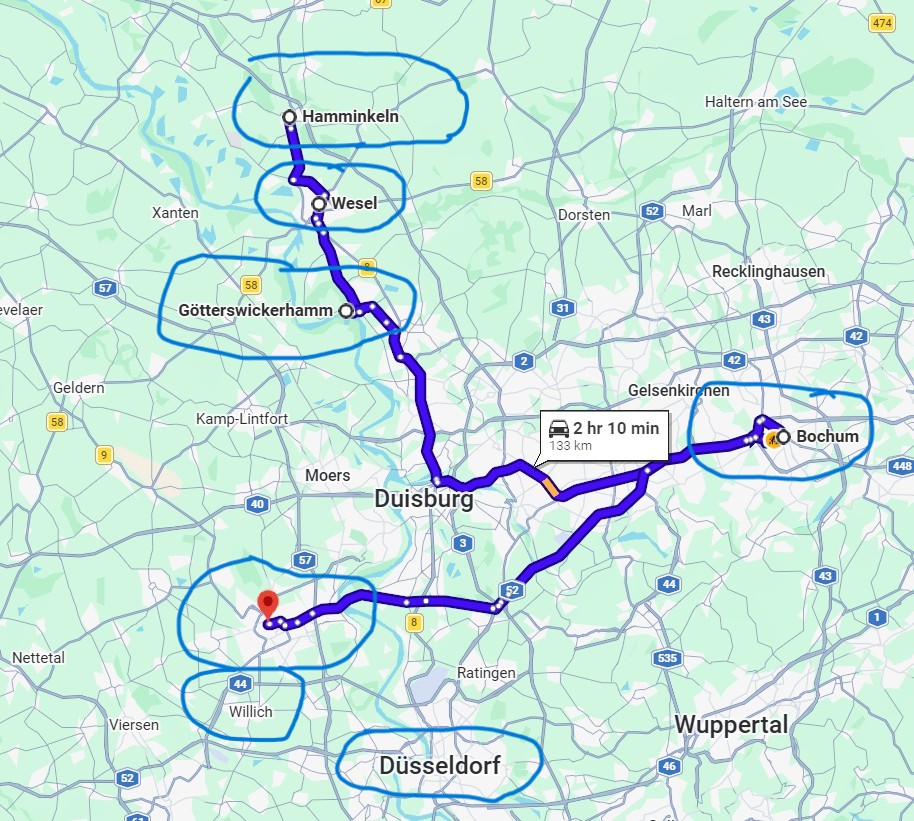
    Moving on to my parternal maternal line, my Great Grandfather, Becker, first worked for the railroad station in Hamminkeln outside of Wesel in Prussia.

    Later on he moved to Wesel and became a police officer. My 2x Grandfather Becker also worked at the rail road station in Hamminkeln. My 3x Great Grandfather Becker was a farmer in a tiny village called Messinghausen.

    Moving onto my maternal line. My Great Grandfather Sevenich also worked for the railroad, most likely in Heerdt and Neuss. Great Grandfather Schneider was a locksmith and he moved around a lot. One of my research friends had suggested that he might have helped built the world famous suspension railway in Wuppertal where he had lived.

    My 2x Great Grandfather Schneider lived in Berlin and was a master goldsmith. My 3x Great Grandfather Büttner was a sugar boiler from Steinwitz living in Berlin.

    My 2x Great Grandfather Ontrup was a damask weaver from Sandhagen living in Gadderbaum near Bielefeld and my 3rd Great Grandfather Hagemann was a shoemaker in Gütersloh.

    How do you like the variety of my ancestors professions? I absolutely love it. What jobs did your ancestors have?

    Please leave a comment below!

  • An Ancestor I admire

    For the year 2026 I am participating in Amy Johnson Johnson’s Crow 52 Ancestors in 52 weeks.

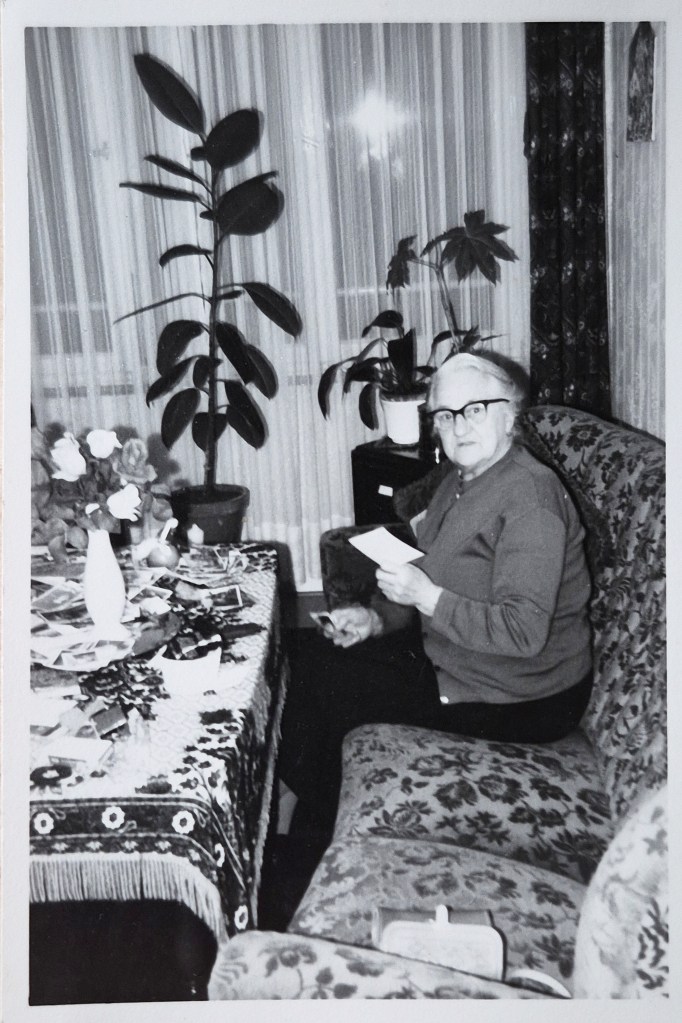
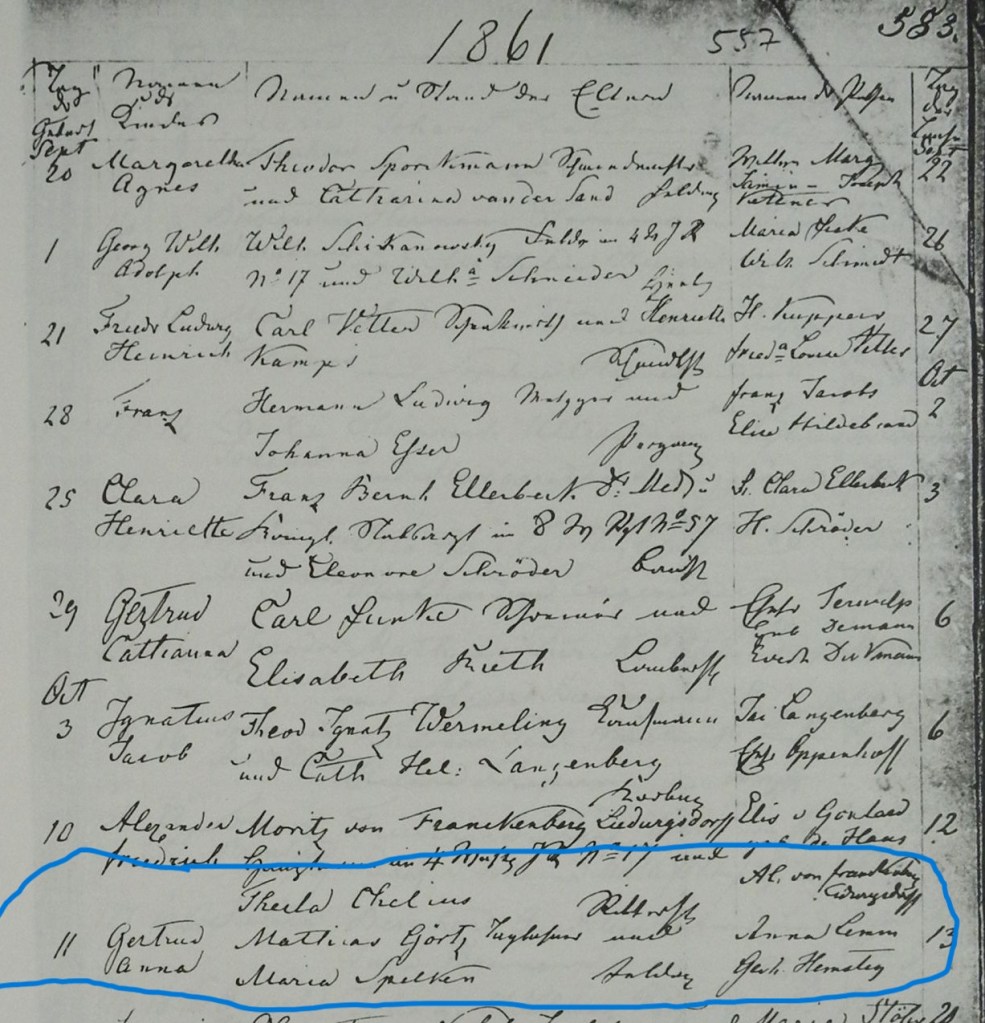
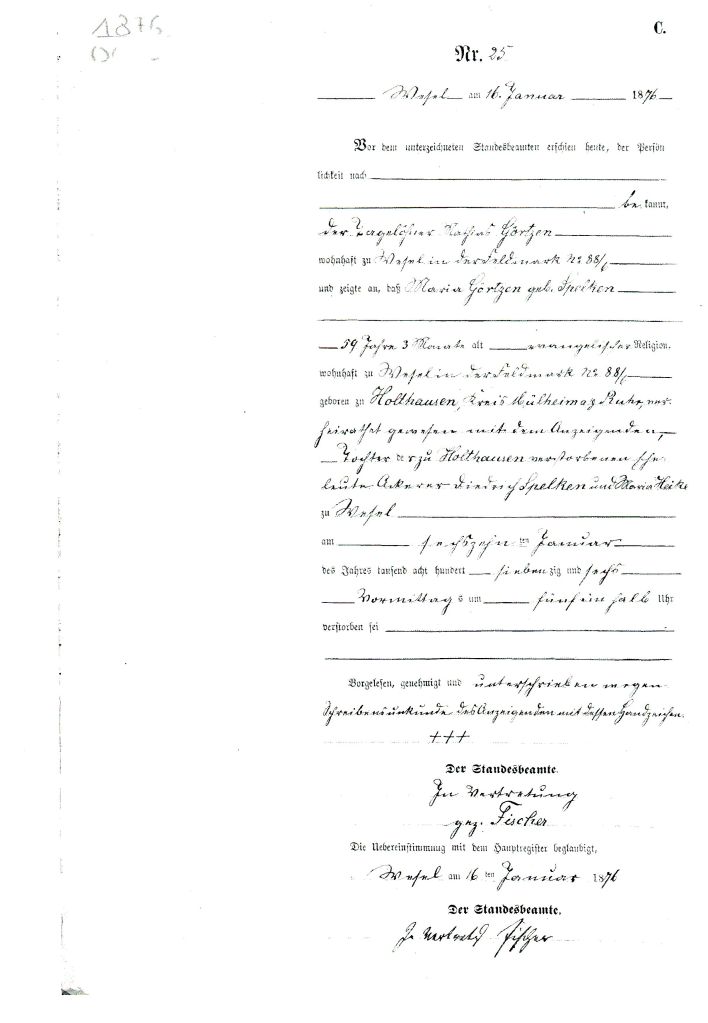
    I didn’t have to look far for the ancestor I admire, it’s my paternal Grandmother, Maria Becker Krings nee Becker. Maria was born in Hamminkeln just about 5km outside of the city of Wesel. Her parents were the policeman Johann Heinrich Becker and his wife Gertruda Johanna Görtzen. Somehow, I always thought my Grandmother came from a big family, because she had eight children herself. So far I have only been a able to find a brother and a sister. More possible birth and baptisms records are not in the public domain yet.

    My Grandmother was always calm, she always smiled and she participated in whatever her large family was up to. I never heard any unkind words from here. She attended church every Sunday.

    Grandma lived through WW1 and WW2. She married my Grandfather, Wilhelm Krings in 1907 in Wesel in the Catholic Sankt Martini Church.

    Martinikirche

    And the inside of the church

    My Grandmother was also baptized in the church and her parents got married there. Unfortunately the church was destroyed during WW2 during British Air Raids.

    My Grandparents raised their family in Düsseldorf were my Grandfather grew up. The first four children, Wilhelm, Trude, Johann and Josef were born from 1907-1914.

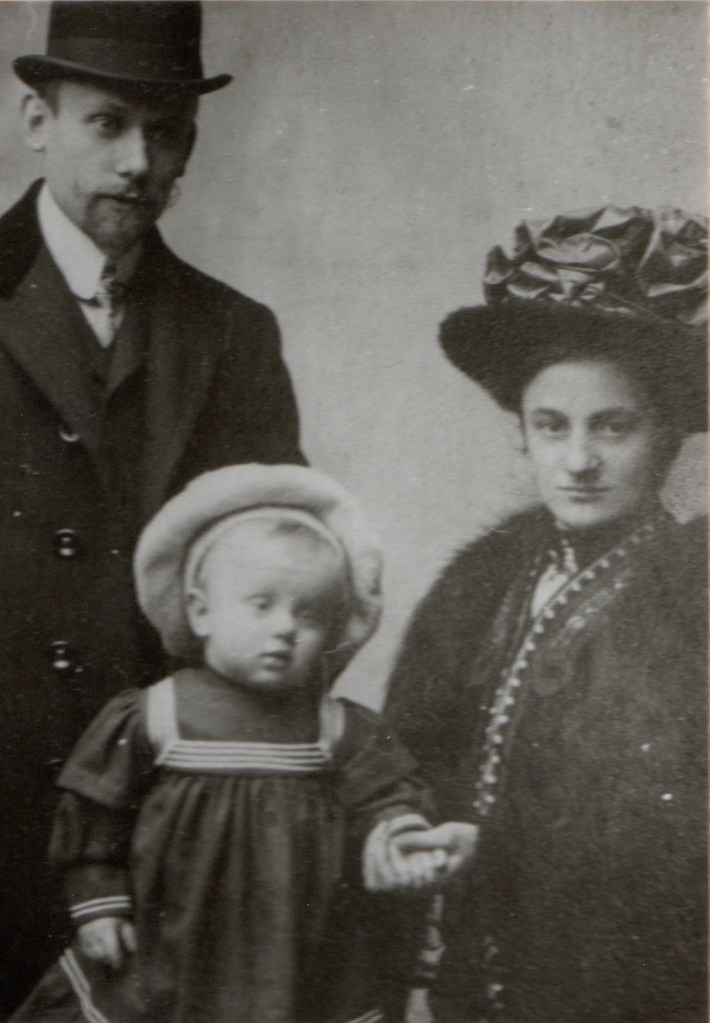
    Wilhelm Krings & Maria Becker With Their First Born Son Wilhelm

    My Grandfather apparently served in WW1 in France and Russia according to a document I found online. It didn’t say where exactly. Unfortunately most military records were destroyed in WW2. My Grandfather came back from WW1 but many men did not. Four more children, Mathilde, Karl (my Dad), Richard and Ursula were born between 1919 and 1929.

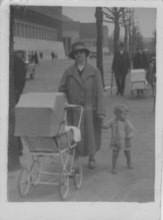
    My Grandmother with two of her youngest children, Ursula walking and Richard in the pram circa 1929 in Düsseldorf.

    Life was good in 1929, their family was complete. My Grandfather had his own upholstery and decoration shop and the family had a nice apartment.

    Fast forward to Christmas 1938. A picture of my Grandmother with most of her children and the first grandchild sitting on her lap.

    Life was still good in this picture before WW2 broke out in the spring of 1939. My Grandmother in the middle, her oldest daughter, Trude and her husband Heinz on the right side. The two youngest, Ursula, smiling and Richard being held by the oldest. My Grandfather on the left side was cut off. My father, Karl, directly behind my Grandmother and behind him his older sister, Mathilde. I don’t know who the young man is behind her. One of my uncles who died after the war is on the right smoking a cigarette and holding a guitar. Two sons are missing, one was Wilhelm who had to move to the mountains because of his asthma and the other one was Josef who had moved to Berlin and later was killed in Russia.

    My Dad and his younger siblings wanted to join the Hitler Youth Groups. Children and teenagers did not have to go to Saturday school if they joined. Thankfully my Grandmother didn’t allow it, otherwise her own children would have spied on her and my Grandfather. It was a very dangerous time in 1938. Freedom of speech didn’t exist.

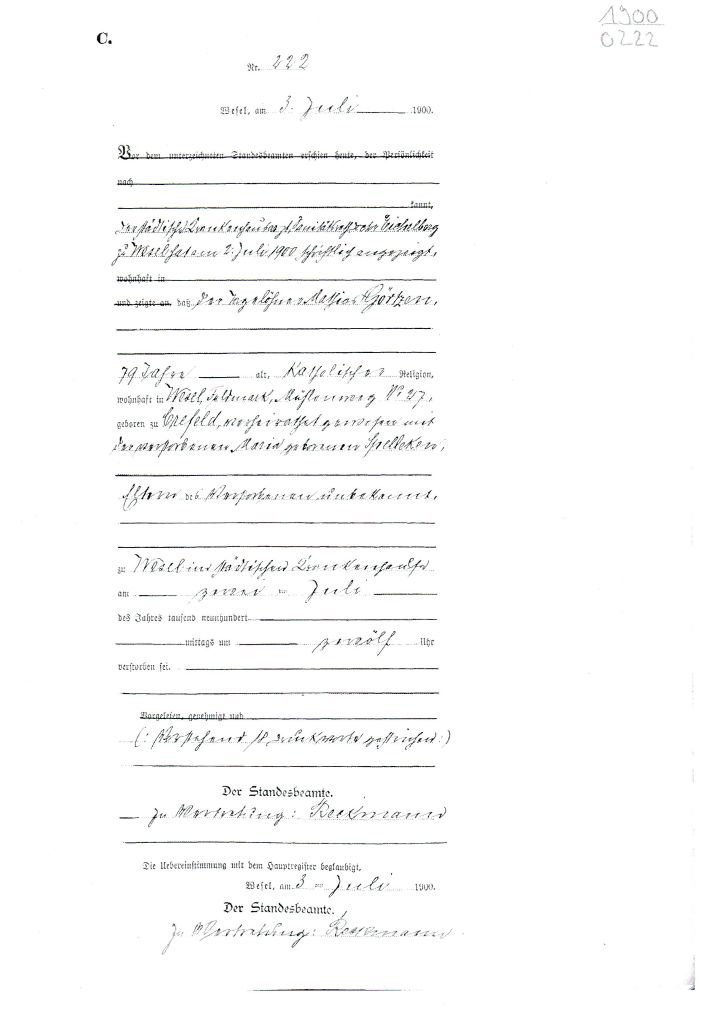
    In 1943 my Grandmother’s Father, Heinrich Becker, was killed in an air raid in Wesel. His body probably was never recovered. His death certificate was not issued until 10 years later. The same year, one of my Grandmother’s son, Josef was killed during a battle in July in Korowina, Russia.

    Josef with his son circa 1942, location unknown

    Also in 1943 her son Karl, my Dad, was drafted into military service. He had no choice in the matter, all the young men had to serve. My Dad was sent to Russia twice, however he kept getting sick and he had an injury on his leg, they released him from military service. He was one of the lucky ones.

    During the war in Düsseldorf my Grandmother and her family were bombed out three times. I don’t know how they managed to find shelter or food, after all they lived in the city and not in the country. There were 243 air raids on Düsseldorf. I can’t even imaging what that was like. My Grandmother lived through it with her family. Even after the war was over, the city was pretty much destroyed. Food was scarce, disease was rampant.

    In 1948 she lost another son, Johann. He died in Düsseldorf. In 1952 she came home to find my Grandfather deceased at the kitchen table.

    My Grandmother had her faith, I think this is what got her through the terrible times and she had her large family which kept growing after the war. She had 17 grandchildren. She attended all their baptisms, first communions and weddings. Her family had a big celebration for her 80th and 85th birthday.

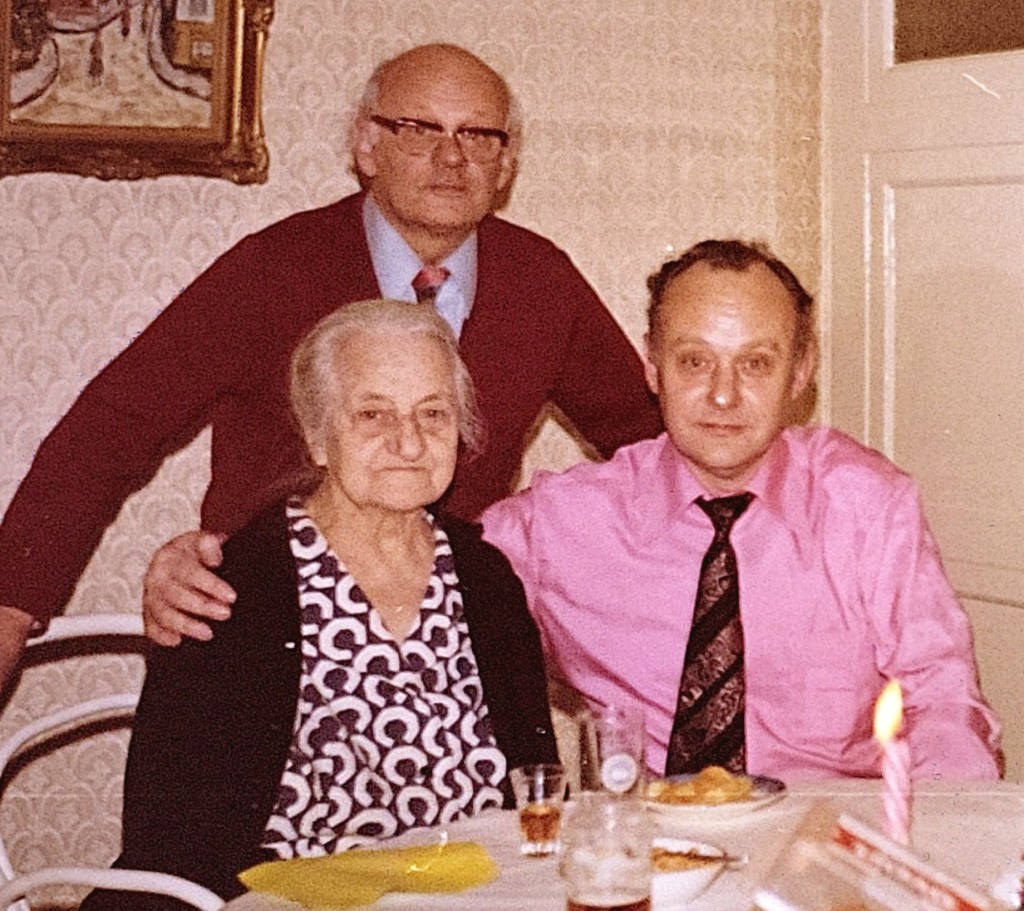
    Grandma with her oldest son Willi and my Dad on his 50th birthday in 1974.

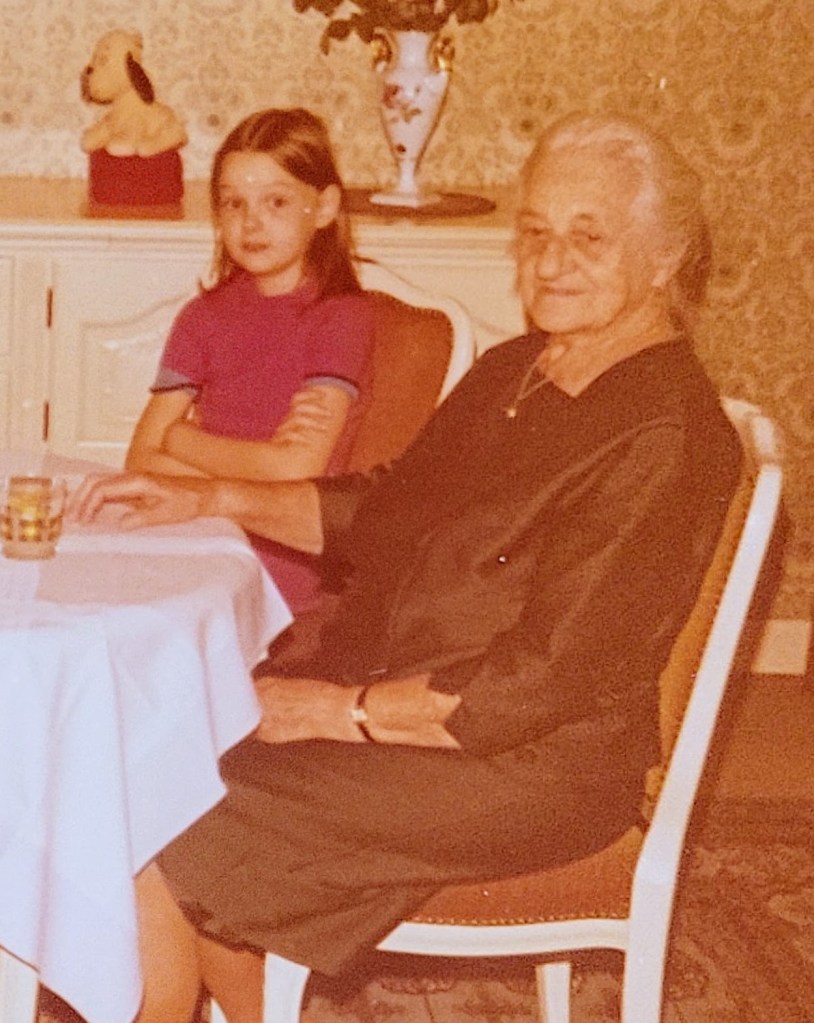
    Grandma and me circa 1973 at home in Düsseldorf

    When I grew up, none of the adults would talk about the war. I never even heard my Grandma talk about her parents or siblings, at least not that I can remember.

    Grandma died in 1975. All the surviving children and all her grandchildren attended her funeral. Her grave was a simple one, just like she would have liked it.

    Despite all the hardship she had to endure, she kept going and she stayed positive. I still miss her and I wished I could talk to her about her family and the war.

    Do you have an ancestor you admire? Please leave a comment below!

  • St. Nikolaus Day

    Last month I wrote about St. Martin’s Day, which we celebrated as children in Germany. Today I will be writing about the holidays season and St. Nikolaus.

    The first of advent which is always on a Sunday starts the official Christmas season in Germany. At home everyone had an Aventskranz (advent wreath).

    We would light the first candle on the first day of advent and the rest of the candles the following three Sundays. Children received an Advendskalender (advent calendar) on December 1st. The calendar had 24 little doors with hidden chocolates. Each day you had to find the door with the corresponding number and open it.

    The calendar would have different characters from Christmas or from fairy tales. My Mother would take me to the store and I could choose one.

    On of the most exciting days in December for us children was St. Nikolaus Day which is always on December 6th.

    The night before, on December 5th, we put our slippers outside of our room and the next morning they were filled with chocolates, nuts and mandarins and small toys. If we had not behaved, St. Nikolaus would leave behind only twigs. In school we would recite poems and sing songs.

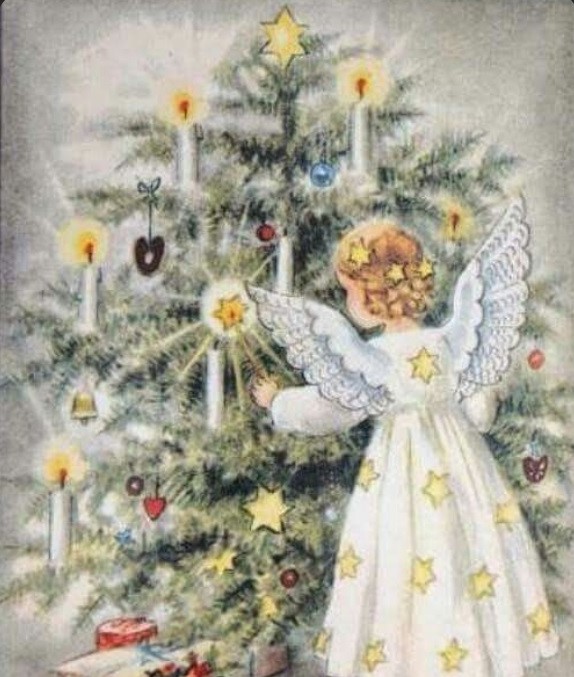
    When I grew up I believed in the Christkind, roughly translated the christ child, which has nothing to with Jesus. She was more like an imaginary angel which would bring the gifts on Christmas.

    When we had beautiful sunsets with red skies my Mother would tell me that this was a sign that the Christkind was baking. Every evening until Christmas I would look outside and wait for the sky to turn red again.

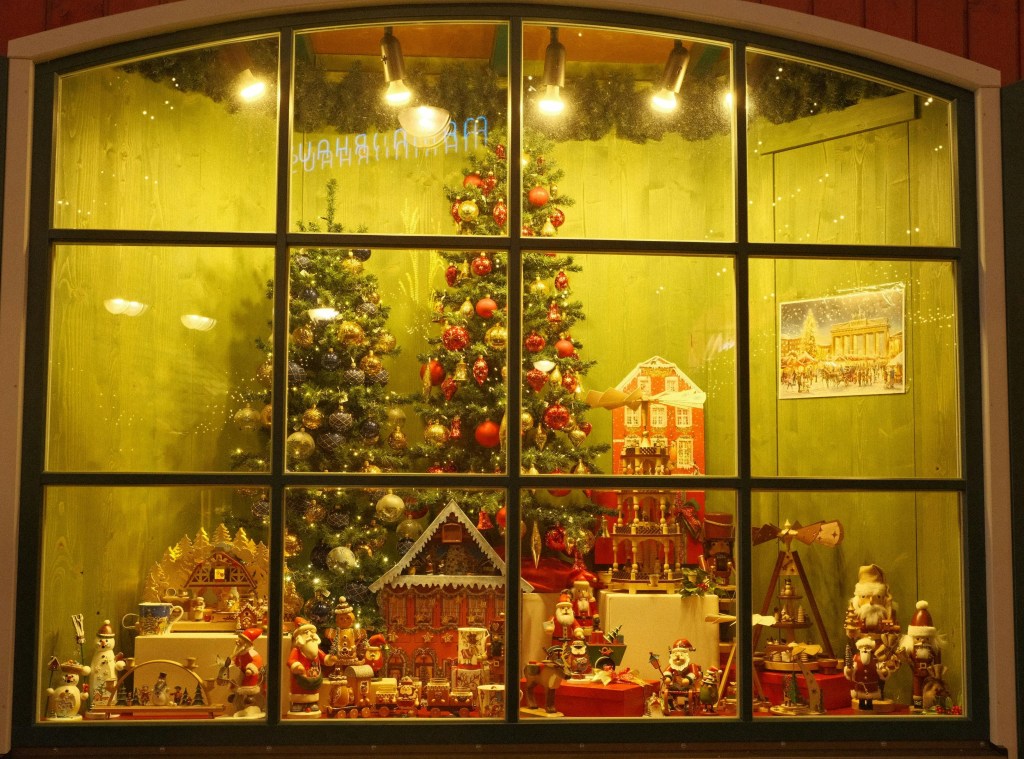
    In the city where I grew up, we would go and look at all the Christmas displays in the store windows.

    At the Christmas market we bought roasted nuts and chestnuts.

    On Christmas eve my Mother shut the living room door and the magic happened while I was sleeping. The Christmas tree went up, be decorated and the Christkind brought the gifts. The next morning, bright and early, I was allowed back into the room filled with lots of presents under the tree.

    The Christmas season in Germany goes through January 6th and ends with Epiphany or Three Kings Day. Children from our church dressed up as kings, roamed through the apartment houses, sang and asked for donations.

    I have wonderful memories of the Christmas season in Germany. My Mother always kept the tree up way past the 6th of January.

    How did you spend the holiday season in your childhood? Please leave a comment below.

  • Every Photo Deserves A Home Charles Kays & Almina Whitworth

    The holidays are approaching fast, so I am trying to reunite more photos with descendants. I found this couple at the Antique Trove in Roseville, California.

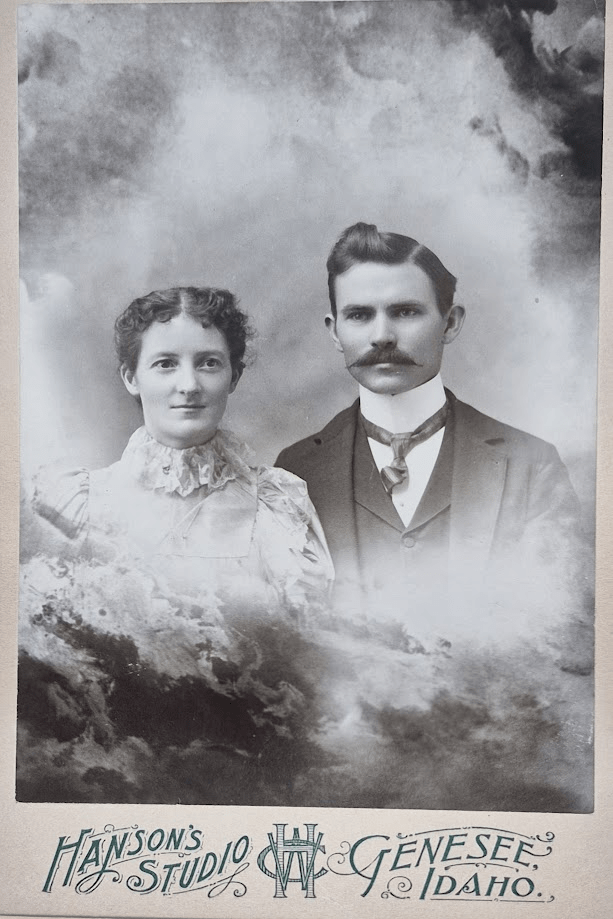
    This photo is of Charles Kays and his bride Almena Whitworth, probably taken on their wedding day, 28 March 1899, in Genesee, Idaho. I found the date in the Western States Marriage index on ancestry. The index itself is available for free here.

    Charles was born in Kansas and Almena in Alabama. In the 1900 Census, the couple lived together with her parents in Moscow, Idaho. By 1910 Charles and Almena had moved to Brawley, California and had three children by the names of Byron 9, Shirley 3 and Katherine 1 years old. In 1920 the family lived in Los Angeles, California together with four children. The youngest one, Virginia was born in 1911.

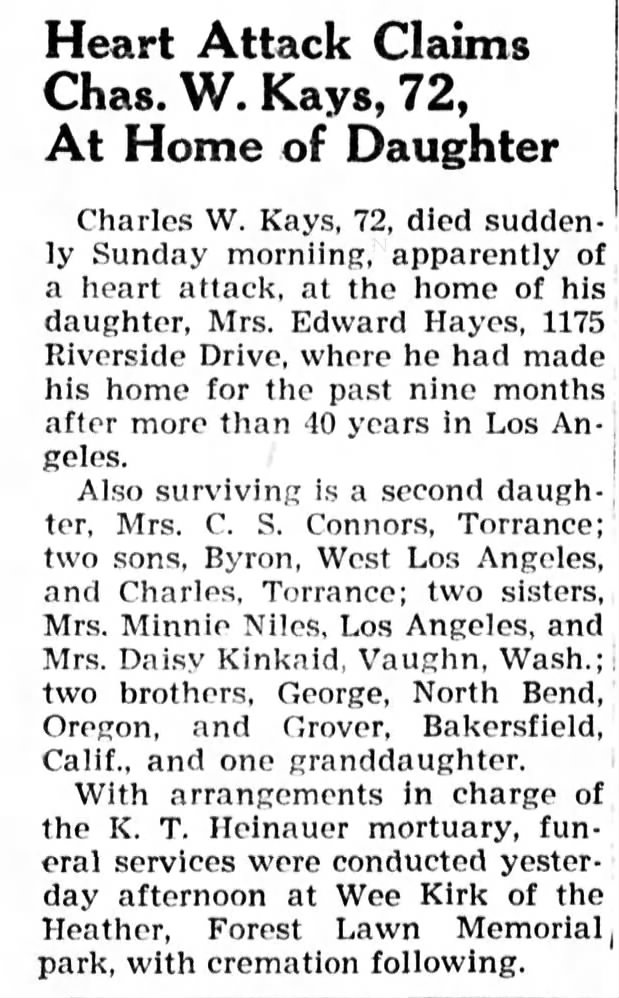
    The oldest child, Byron, was married by 1930 and lived in Los Angeles with his wife Marion. The 1940 Census shows one child, Barbara 7 years old. Byron’s Father, died suddenly in 1945 of a heart attack.

    Chino Champion

    Chino, California • Fri, Jan 19, 1945Page 1

    The obituary mentioned Byron, his sister Mrs. Edward Hays, Mrs. C.S. Connors and the youngest sibling Charles all living in the Los Angeles area. No mention of Byron’s mother. She must have died earlier.

    Byron’s only daughter, Barbara was born in 1933. I have not been able to find much more information about her, plus I do try to protect the privacy of descendants.

    Byron’s younger brother Charles Shirley Kays was born in 1907 in Arizona and died 1971 in Eureka, California. He was married twice. I found one daughter on Find A Grave.

    Byron’s sister Catherine Victoria was born 1908 in Oregon and died 1962 in California. I found her and her husband Edward Hays in the 1940 and 1950 Census with no children.

    The youngest sibling Almina Victoria was born 1910 in California. She died young just liker her sister in 1964. She was married to Cornelius Connors. I found one son in the 1950 census.

    I have found a few online family trees which I will contact first to see if they are interested in the photo.

    I have been successful with my first two attempts of trying to return photos.

    I wrote about three sisters a few months ago.

    Have you ever had the privilege of returning a photo or other mementos to strangers rather than your own family?

    Please leave comment below!

    Thank you for reading my blog and I wish you a Happy Thanksgiving which we are celebrating this Thursday here in the United States.

  • Every Photo Deservers A Home Minnie & Rose Middlebrook

    A few months ago I started a new series within my blog to find descendants for orphaned photos I find at antique malls, flea markets and thrift stores. The first one about photos of three sisters in July was successful. You can read about it here.

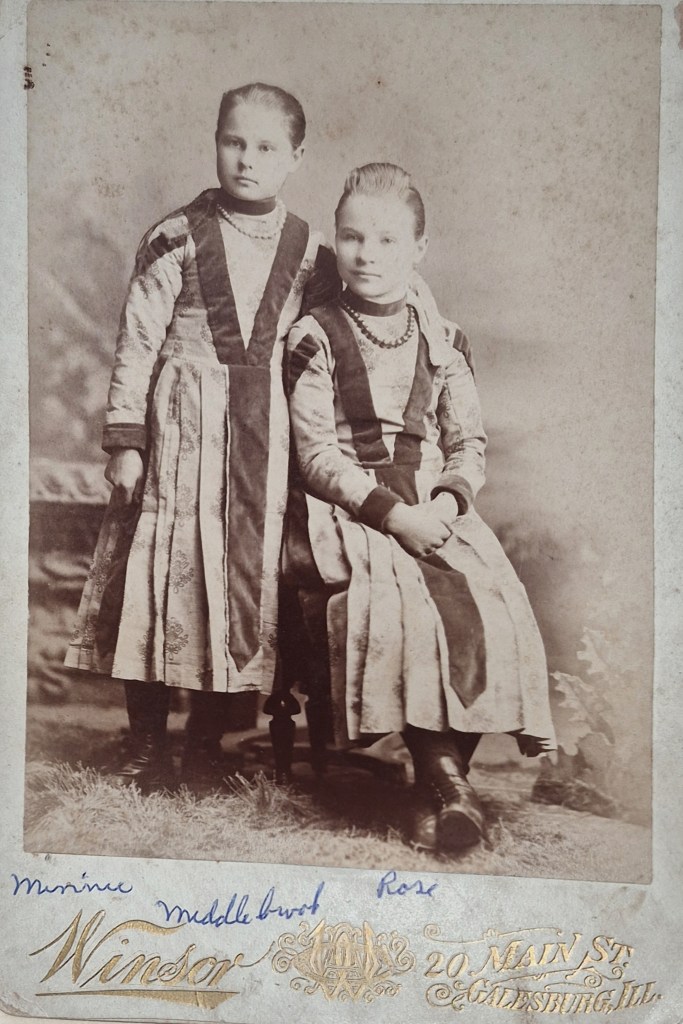
    Today I am trying to find a home for the siblings Minnie and Rose Middlebrook.

    The picture was taken in Galesburg, Illinois.

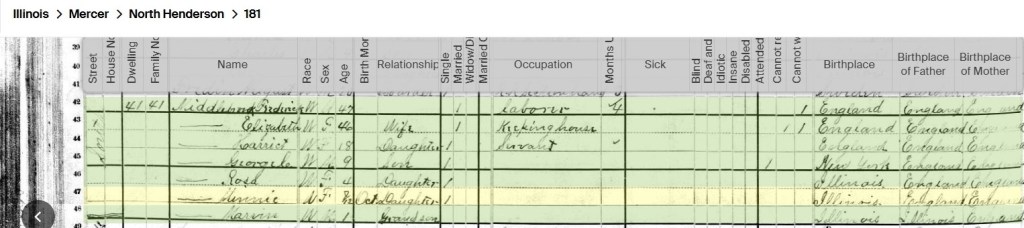
    The 1880 Census shows the sisters and their family living in North Henderson, Mercer County, Illinois.

    Their parents Frederick and Elizabeth, 47 and 46 years old, were born in England. Their older sister, Harriet 18 years old, was also born in England. Brother George, 9 years old, was born in the state of New York. Rosa, 4 years old and her sister Minnie 7.5 months old, were both born in Illinois. Their nephew, Marvin, was 1 year old. We now have the birth years for the sisters. Rosa was born in 1876 and Minnie in 1879.

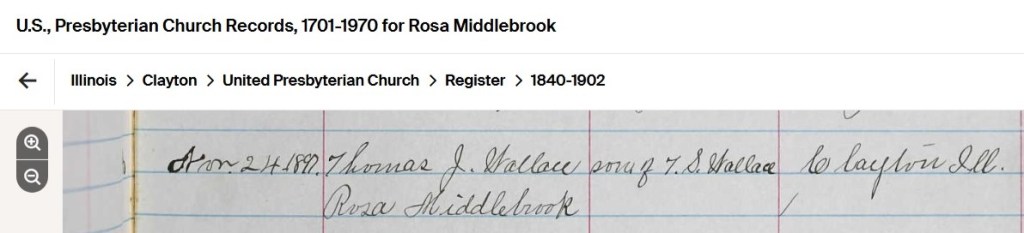
    Rosa married Thomas J Wallace 14 January 1897 in the United Presbyterian Church, in Clayton, Illinois.

    In the 1900 census, Rose and Thomas lived in Clayton together with their 3 months old daughter, Minnie. In the 1910 census they live together on a farm in Council Grove, Oklahoma with their children Edo Minnie 10, Edward 9, and Shannon 6 years old. In the 1920 Census the family lives together in Garber, Garfield, Oklahoma. The children being 20, 19 and 16 years old.

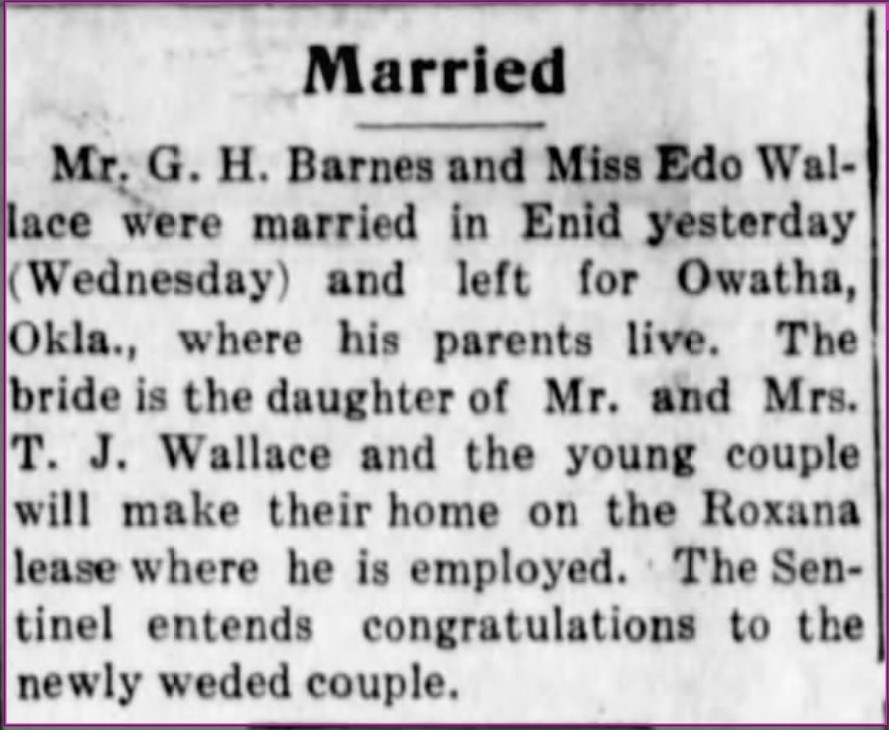
    Starting with the oldest, Edo Minnie, she married G H Barnes in 1920 in Enid, Oklahoma.

    In the 1930 Census, Harold and Minnie Wallace, live together with their three children, Lulu R 8 and Edo 5 years old, in Cameron, Texas. Harold works for a service station. In 1940 the family lived still together in the same town. Lula Rose was 18 and Edo May 15 years old.

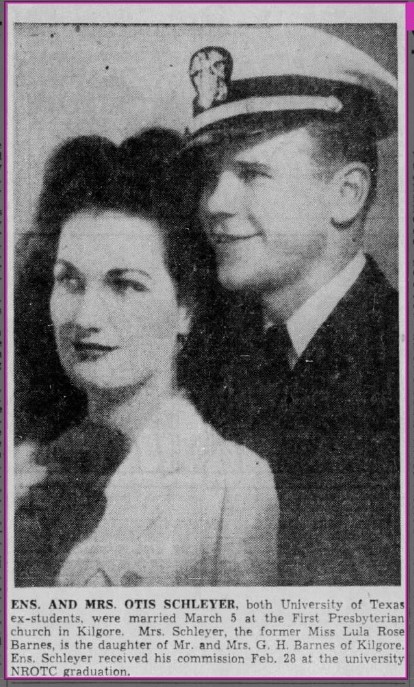
    Lula Rose married Otis Schleyer, 5 March 1944 in Kilgore, Texas. The newspaper had announced their wedding.

    Source: The Austin American

    Austin, Texas · Tuesday, March 14, 1944

    Lula Rose had at least 2 children and one grandchild.

    Edo May, Lulu’s sister was born 1925 in Oklahoma. She married twice, had one son, one adopted son and step children.

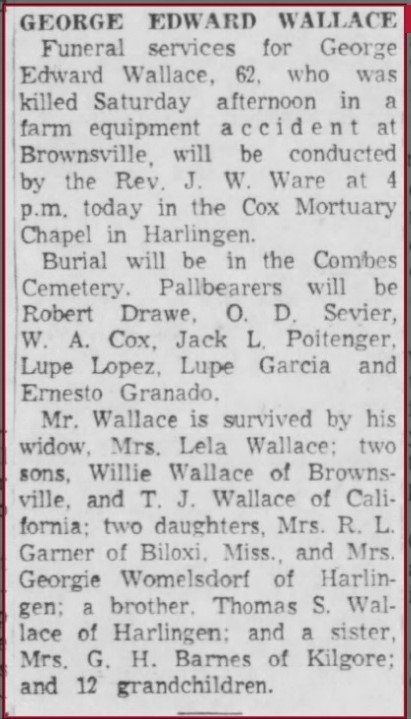
    Rosa Middlebrook’s second child, Edward George Wallace was born 1901 in Illinois and died 1963 in Brownsville Texas. He was married, had two sons, two daughters and 12 grandchildren. I found his obituary online as well as his death certificate.

    Source: Valley Morning Star

    Harlingen, Texas · Tuesday, July 02, 1963

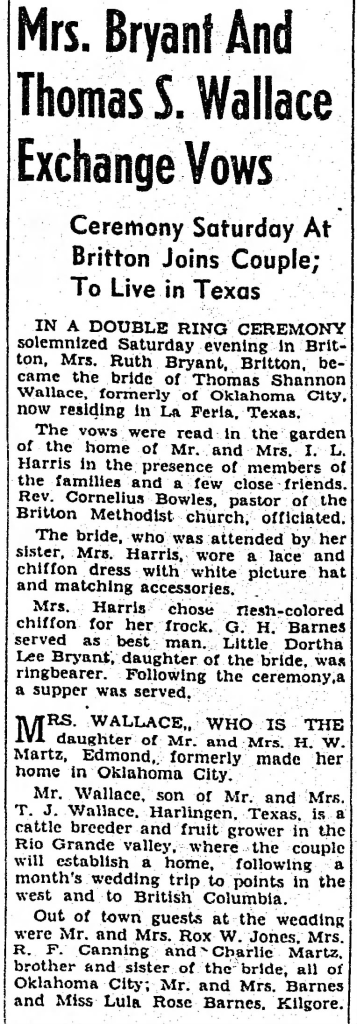
    The youngest child of Rosa Middlebrook, Thomas Shannon Wallace, was born 1906 in Missouri. He married Ruth Bryant in 1940 in Oklahoma, Texas.

    The couple had at least two daughters. One them got married, however I don’t know if they had children.

    Now let’s take a look if I can find descendants of Minnie Middlebrook. She married Edward C Smith 15 February 1899 in Mercer County, Illinois. In the 1910 Census, the couple lived in Avena, Fayette, Illinois with their two children George E Smith 8 and Gladys 6 years old.

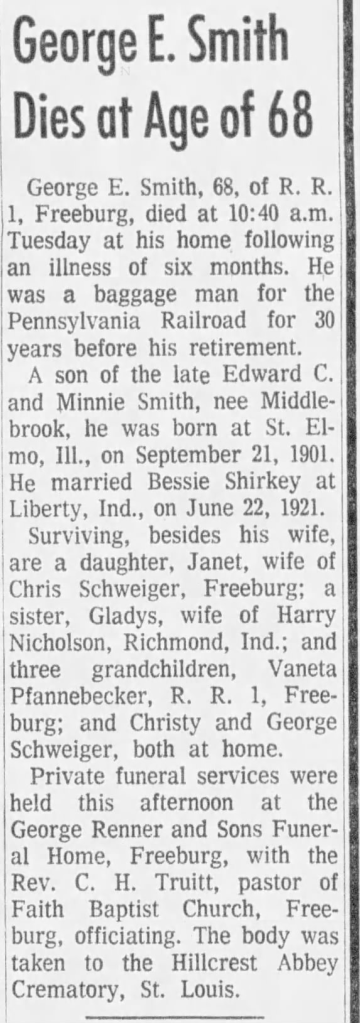
    I found George’s obituary from 1970. He married Bessie Shirkey 22 June 1921 in Libertry, Indiana. They had a daughter named Janet who married Chris Schweiger. They had three children.

    The Belleville News-Democrat

    Belleville, Illinois • Wed, Feb 18, 1970Page 2

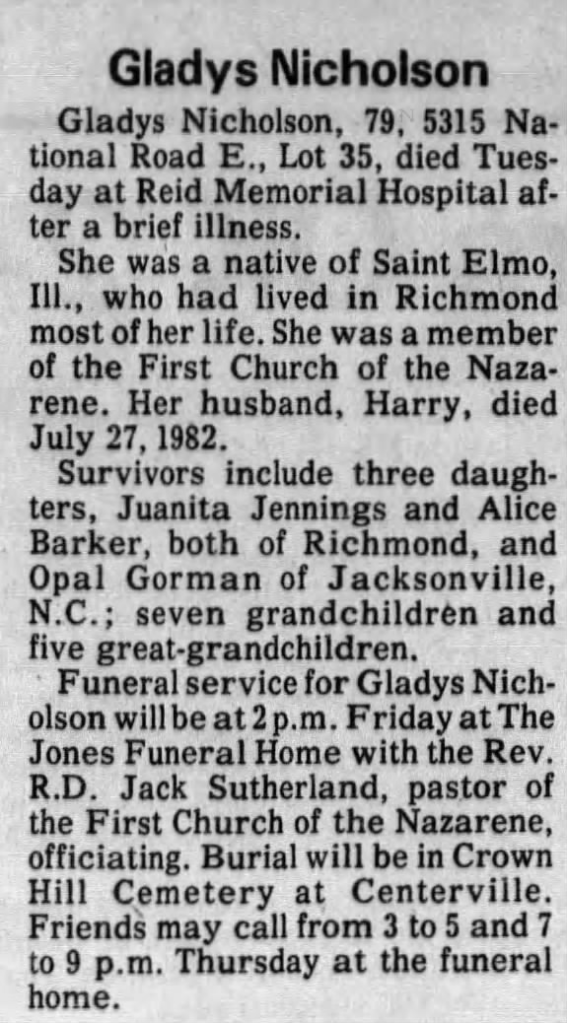
    George’s sister Gladys was born 21 January 1904 in Illinois and married Harry Nicholson 3 February 1923 in Indiana. I found her obituary as well. Gladys died in 1983. They had three daughters, Juanita, Alice and Opal, seven grandchildren and five great grandchildren.

    Palladium-Item

    Richmond, Indiana • Wed, Oct 5, 1983Page 8

    Minnie and Rose Middlebrook both have lots of descendants. Hopefully I will make contact with one of them soon, so the girls can be returned to their family.

    Have you ever returned old photos or other mementos to strangers?

    Please leave a comment below!

  • St. Martin’s Day

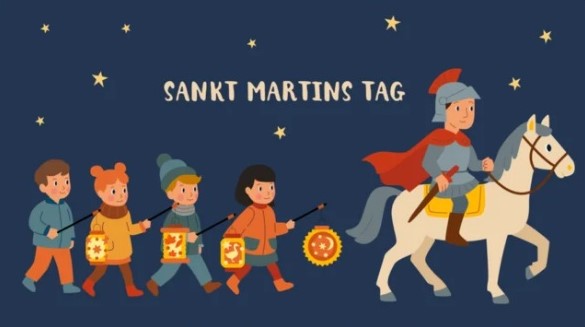
    In Düsseldorf, Germany where I grew we celebrated St. Martin’s Day on November 11th. Every year in elementary school we mad lanterns for the parade. A tea light was used for illumination.

    When it started to get dark, we met in the school yard with our lanterns. St Martin on his white horse and with his red cloak led the parade through the part of the city where I lived. The band played music and we sang St. Martin songs. The most famous one was: “Ich geh mit meiner Laterne und meine Laterne mit mir”. Translation: “I walk with my lantern and my lantern with me”. At the end of the parade we returned to the school yard and St Martin would share part of his cloak with a beggar.

    After the parade we children would go from store to store and receive candy and other goodies. The bakeries would give out Weckmänner.

    It’s a sweet bread with raisins and a pipe. After eating it we would pretend to smoke the pipe.

    Martin was a roman soldier in the fourth century who shared his cloak with a freezing beggar. According to legend, that night he had a dream in which Jesus Christ appeared and carried half of his cloak. This prompted him to become a soldier and later a bishop in Tours, where he became known for his charity and humble lifestyle.

    Martin was born in Hungary around 316 AD and served as a Roman soldier. He was 17 years old when he performed the famous deed.

    One cold winter day, he encountered a freezing beggar outside the gates of Amiens. Having only his sword and cloak, he cut the cloak in half and gave one half to the man to save him from the cold.

    During the night, Christ appeared to him in a dream, wearing half the cloak, and told him that with his act he had clothed Christ himself.

    After this experience, Martin was baptized and left the army. He later became a monk and founded the first monastery in Europe.

    Although he initially hid from the office, he was consecrated Bishop of Tours. Even as a bishop he lived very modestly and dedicated himself to the poor and needy.

    He died November 8, 397 and was burred on November 11. To this day, he his venerated as a saint and on St. Martin’s Day he is commemorated with lantern parades and roast goose.

    Did you celebrate St. Martin as a child?

    Please leave a comment and/or subscribe!

  • Mary Anne Sinclair Frost’s Unsual Family

    Mary Anne Sinclair was born 11 October 1837 in Cape Town, South Africa. She was the daughter of Thomas Kenneth Sinclair and Maria Magdalena Weingartz. She was also the granddaughter of my distant cousin, Adamus Paulus Weingartz, who immigrated to South Africa, from Düsseldorf, Prussia via the the Netherlands in 1787. I blogged about Adamus a while ago. You can read about him here.

    Mary Anne married Frederik Dunch Frost 12 October 1855 in Cape Town, South Africa. Frederik was born 22 June 1828 in Stepney, England. The couple had their first child, Frederik James, on 31 July 1857 in Capetown. He was baptized 28 August 1857 in St. Georges Church in the same town. I have no further information on Frederik, he might have died very young.

    The young family then left South Africa and went to England. Their second child, Sara Perry Frost was born 30 November 1858 at sea. In the 1861 England Census we find Sara and her parents in Middlesex. No sign of her brother Frederik. The father’s profession was mariner or sailor.

    Sara stayed single her whole life. I found her in the 1881, 1891, 1901 and 1911 Census. She never married and she never worked. May she inherited some money. Sara died in January 1938.

    Sara’s sister Mary Magdalena Frost was born 18 June 1860 in Shadwell, London. I also found Mary in several censuses in England and she never married. In fact I found her living together with Sara and a younger, sister, Alice Mary Frost in 1921. Alice Mary also never married.

    Mary died April 1935 in Conway, Wales. So, why did the sisters not get married?

    The fourth child, Angelina Anna Frost was born circa 1862 and you guessed it, was also a spinster. She died in March 1900. What is going on in this family?

    The fifth child, Alice Mary Frost, was born 1863 in Islington, London and died in July 1939 in Surrey, England. I already mentioned her earlier, living together with her other unmarried sisters. We know have four sisters, all unmarried. Let’s take a look at the rest of the siblings.

    The sixth child, Frederick James John Frost was born in 1866. He left England and immigrated to Ohio, USA in 1892. He married Gertrude Mae Walker 11 October 1899 in Trumbull, Ohio. The couple had three children, Florence, Dorothy and Frederick Theodore. Frederick James died 13 August 1936 in Youngstown, Ohio and Gertrude died 27 January 1948 in Warren, Ohio. Their children Dorothy and Frederick both married. I couldn’t find a marriage or death date for Florence.

    The seventh child, Ada Frost, was baptized 31 May 1867 in Surrey, England. I did find her in the 1891 and 1901 England censuses. I couldn’t find anything specific after the 1901 census.

    The eighth child, Henry James Frost was baptized 20 September 1868 and died in October 1952 in Surrey, England. I did not find a marriage for him.

    The ninth child, Claud Frost, was baptized 10 April 1873 in Surrey. He married Rose Mabel Ledbrook 3 September 1902 in Saint Mark, England. They had three children together, Barbara, Evelyn and Phillip. I haven’t been able to find any marriages for them.

    The tenth child, Elsie Maude Frost, was baptized 22 January 1875 in Lambeth, England. I found her in the 1881, 1891, 1901 and 1911 England censuses plus in the 1939 England and Wales Register. Yes, you guessed it, she was not married either.

    The eleventh child, Albert George Frost, was born circa 1876. He immigrated to Australia and married Madeleine Henrietta Bode 7 April 1899 in Queensland, Australia. The couple had three children, Horace, Vivian and Adrian.

    The twelfth child, Horace Frost, was baptized 24 August 1877. I was able to find him in census records. In 1911 he lived together with his sisters, Sara and Elsie Frost. I have no specific dates for him after that.

    The last child, Leslie Howard Frost, was born in 1879 and died in 1880

    This family is mind boggling. None of the girls go married! Two of the boys went to America and Australia respectively. One stayed in England.

    Have you ever encountered such a family in your research? Leave a comment below.

  • Cemeteries

    Just last week we visited another cemetery. We were supposed to go to Point Loma, however due to the federal government shut down it was closed. Instead we decided to stop by Fort Rosecrans National Cemetery. It is a federal military cemetery in San Diego with some of the same views you can see from Point Loma.

    When I took the pictures I didn’t realize that the graves all faced the San Diego bay. It is a beautiful and peaceful place with lots of sunshine and probably a lot of fog at times.

    The cemetery is located on 75 acres and has more than 120,000 interments. It’s the final resting place for military personal since 1846. The gold rush didn’t start until 1849 and California became a state in 1850.

    In September I went to the famous Virginia City Cemetery in Nevada. It felt like I travelled back in time. The cemetery is located on a huge hill and grouped by professions and religions, goes on forever. Most of the people buried there, were born in other countries. I found many graves of Germans, British and Irish descent.

    The cemetery was established in the 1860’s and about 5000 people are buried here. If you walk the cemetery, bring water and sun screen. Good walking shoes are preferred. Best time to visit is October.

    In June we went to the Carmel Mission in California. I took one picture of the cemetery.

    How many people are buried here, is unknown. The cemetery was established in 1771.

    Last year in September we went to two cemeteries in Europe. The first one was in Lauterbrunnen, Switzerland.

    Lauterbrunnen cemetery is nestled in the beautiful Swiss mountains with a view of the famous waterfalls.

    We also visited Berchtesgarden cemetery in Germany.

    This cemetery is nestled in the beautiful Bavarian Alps.

    Please note that every picture was taken by me.

    If you liked reading this article, please leave a comment and/or subscribe. Thank you!